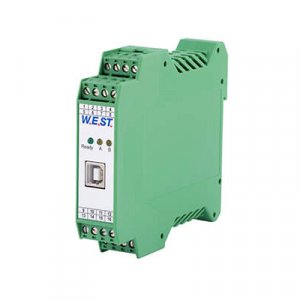


Description
The PAM-199-P-IO is a universal power amplifier designed to control directional control valves or two pressure or throttle valves, each fitted with a solenoid.
Here is a summary of the key features and characteristics:
- Order number: PAM-199-P-IO
- Interface: IO-Link Class A port. Complies with the V1.1 specification with a data rate of COM3 = 230.4 kBaud. The port is electrically isolated from the power supply, which makes it particularly immune to interference.
- How it works: The setpoint is specified via IO-Link. The output stage and ramp function are enabled via an ENABLE signal, which consists of both a hardware and a software enable. Fault-free operation is indicated by a READY signal.
- Operating modes:
- DIR: For controlling a directional control valve. The setpoint is specified via a bipolar numerical value in IO-Link setpoint channel A.
- IND: For controlling one or two throttle or pressure valves. The The setpoint is specified using two positive numerical values in the IO-Link setpoint channels A and B.
- Output current: The output current of the PAM-199-P-IO is regulated and is therefore independent of the power supply and the magnetic resistance. The output stage is monitored for cable breaks, is short-circuit-proof and switches off the power output stage in the event of a fault.
- Parameterisation:
- Digital, reproducible setting.
- Free configuration of ramps, MIN and MAX, dither (frequency, amplitude) and PWM frequency.
- Characteristic curve linearisation using 10 XY points per direction.
- Application-oriented parameterisation.
- Configuration via USB using the WPC-300 software or via IO-Link.
- Analogue inputs: Two additional analogue inputs are available, with signal transmission via IO-Link.
- Current ranges: Can be configured via software up to 2.6 A.
- Adaptation: All standard proportional valves from various manufacturers can be controlled (BOSCH REXROTH, BUCHER, DUPLOMATIC, PARKER, etc.).
Typical applications: Control of directional, throttle and pressure valves that require flexible adjustment. Hydraulic applications in open-loop or closed-loop control systems.