


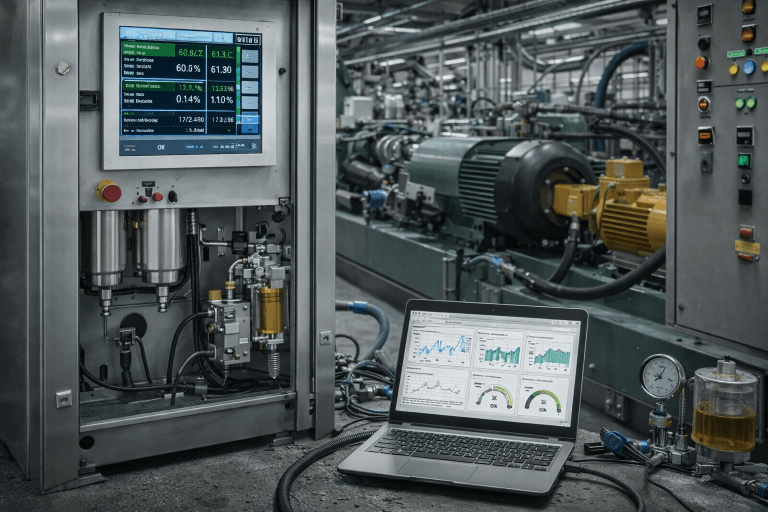

MP Filtri ICM 2.0 – In-line particle counter with LED measurement technology
The ICM 2.0 is an in-line particle counter featuring advanced LED measurement technology for exceptionally fine particle resolution. It continuously measures solid contamination, temperature and relative humidity, and is designed for permanent installation within a hydraulic circuit. The ICM can be operated either manually on the unit itself or via remote control (PC, laptop, tablet) and can be integrated into a higher-level plant control system.
About ICM 2.0 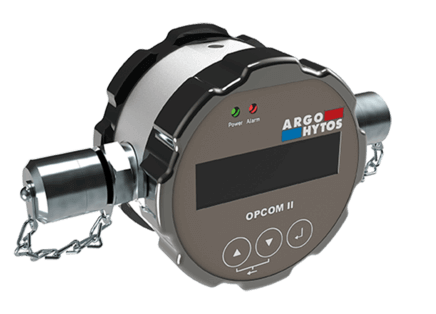
Argo-Hytos OPCOM particle counter
The OPCOM from Argo-Hytos is a tried-and-tested online particle counter designed for permanent installation in hydraulic circuits. It enables automatic monitoring of the oil purity class and can be integrated into plant control systems.
About OPCOM 
CML4 – The portable condition monitoring device for field use
The CML4 is a robust, portable contamination monitoring device designed specifically for field use. It operates using the light-blocking method and offers:
• Long battery life for all-day outdoor use without recharging
• A high-resolution colour touchscreen display suitable for use in sunlight
• Storage of up to 4,000 data sets
• Data analysis and reporting (PDF) via the “CMP View” software
• Rapid decision-making support in the field without the need for external laboratory facilities
This means that oil analyses are not only documented but actively integrated into the operational strategy.
About the CML4 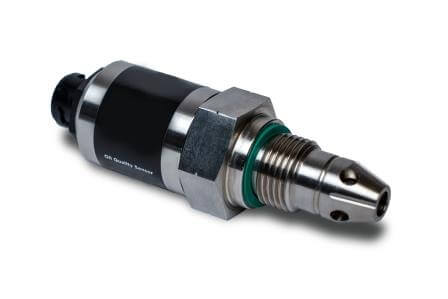
LOQS Oil Quality Sensor
The LOQS sensor (OQS) detects all types of wear and contamination: water, acid, fuel, changes in viscosity, different types of oil, carbon and particles. Changes in oil quality are detected with a sensitivity of 0.01 per cent (10 ppm) and an accuracy of ±0.5 per cent. The sensor reports every two seconds and has a proven track record worldwide for use in extreme industrial environments. Plug-and-play integration is possible.
About LOQS 
Argo-Hytos LubCos H2O+ II
The LubCos H2O+ II is a stationary screw-in sensor for the continuous monitoring of oil condition. It measures oil moisture and temperature in hydraulic and lubricating oils – suitable for continuous operation in installed systems.
About LubCos H20